Diet
Fertility Diet for Women with Obesity
What to Eat When You’re Trying to Conceive
Published on GuideBlogs | Health & Wellness
A close friend of mine spent almost two years trying to conceive before anyone actually sat her down and explained the connection between her weight and her cycles. She’d been to two gynecologists, had every hormone test under the sun, and was told to “just relax and it’ll happen.” It wasn’t until a third doctor gently brought up her weight — and actually explained why it mattered, not just that it did — that things started to click for her. Six months into a structured, realistic eating plan and a modest 8% drop in her weight, her periods regularized for the first time in years. She conceived four months later.
I’m telling you this because if you’re reading this article, there’s a good chance you’ve heard “lose weight” from a doctor as a throwaway line, without anyone explaining the actual science — or worse, without any real plan for how to do it. That’s not fair, and it’s not helpful. So let’s actually talk about it: why obesity affects fertility, and exactly what a realistic, sustainable eating plan looks like for someone trying to conceive.
Why Weight Actually Affects Fertility
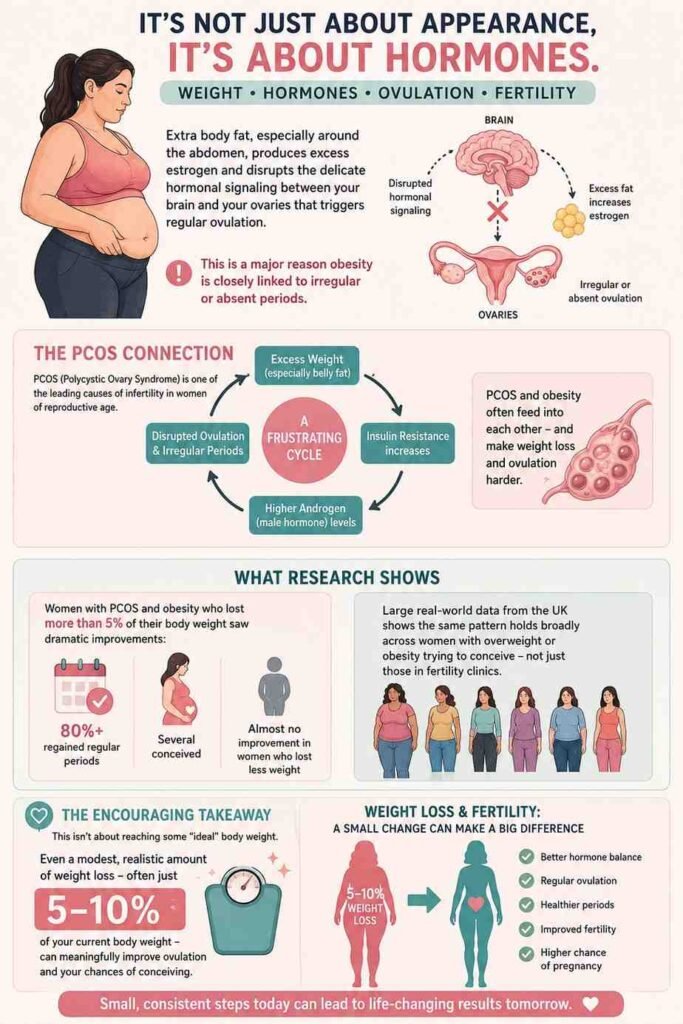
This isn’t about appearance — it’s about hormones, and specifically about ovulation. Extra body fat, particularly around the abdomen, produces excess estrogen and disrupts the delicate hormonal signaling between your brain and your ovaries that triggers regular ovulation. This is a major reason obesity is closely linked to irregular or absent periods.
It’s also deeply tied to PCOS (Polycystic Ovary Syndrome), one of the leading causes of infertility in women of reproductive age. PCOS and obesity often feed into each other — excess weight worsens insulin resistance, which raises androgen (male hormone) levels, which further disrupts ovulation, which in turn makes weight loss harder. It’s a frustrating cycle, but an important one to understand, because it’s also where the most effective interventions work.
Research consistently shows that weight loss improves the chance of pregnancy in women with obesity or overweight — including women without PCOS, and even more so in those with it. In one study, women with PCOS and obesity who lost more than 5% of their body weight saw dramatic improvements: most regained regular periods, and several conceived, compared to almost no improvement in women who lost less weight. Large real-world data from the UK found the same pattern holds broadly across women with overweight or obesity trying to conceive, not just those in fertility clinics.
The encouraging takeaway: this isn’t about reaching some “ideal” body weight. Even a modest, realistic amount of weight loss — often just 5–10% of your current body weight — can meaningfully improve ovulation and your chances of conceiving.
What Should You Actually Eat? Building Your Fertility Plate
There’s no single “fertility diet” magic formula, but the research consistently points to a few clear principles. Think of this less as a strict diet and more as a way of eating you can sustain for months, since fertility improvements take time to show up.
1. Prioritize Low-Glycemic, Complex Carbohydrates
Since insulin resistance is central to both obesity and PCOS-related infertility, managing blood sugar spikes matters enormously. Swap refined carbs — white rice, maida-based foods, sugary snacks — for complex, slow-digesting options:
- Whole grains: brown rice, oats, quinoa, whole wheat roti
- Legumes: lentils, chickpeas, rajma
- Non-starchy vegetables in generous portions
This isn’t about eliminating carbohydrates. It’s about choosing the ones that don’t spike your blood sugar and worsen insulin resistance.
2. Make Protein the Center of Every Meal
Protein helps steady blood sugar, supports satiety (so you’re not constantly hungry while eating fewer calories), and helps preserve muscle mass during weight loss. Good sources include eggs, fish, chicken, paneer, tofu, Greek yogurt, and dal.
A practical target: aim to have a clear protein source at breakfast, lunch, and dinner, rather than treating it as an afterthought.
3. Include Healthy Fats, Not Zero Fats
A common mistake is going extremely low-fat when trying to lose weight, but healthy fats are actually essential for hormone production. Include:
- Olive oil, ghee in moderation
- Nuts and seeds (almonds, walnuts, flaxseeds, chia seeds)
- Fatty fish like salmon or sardines, if you eat non-vegetarian
4. Fiber Is Your Quiet Ally
High-fiber foods slow digestion, help control blood sugar, and support a healthy gut, which is increasingly linked to hormone regulation. Vegetables, legumes, whole fruits (not juice), and whole grains all help here — and most people simply aren’t eating enough of it.
5. Reduce, Don’t Eliminate
Refined sugar, deep-fried foods, and heavily processed snacks are the biggest culprits behind insulin resistance and inflammation. You don’t need to swear off everything forever — cutting back consistently matters more than occasional strict perfection followed by giving up entirely.
A Sample Day of Eating
Here’s what a realistic, fertility-supportive day might look like:
| Meal | What to Eat |
|---|---|
| Breakfast | Vegetable oats or eggs with whole wheat toast |
| Mid-morning | A handful of almonds or walnuts |
| Lunch | Dal, brown rice or one roti, a big portion of vegetables, curd |
| Evening snack | Roasted chana or Greek yogurt with berries |
| Dinner | Grilled fish/paneer/tofu, sautéed vegetables, small portion of whole grain |
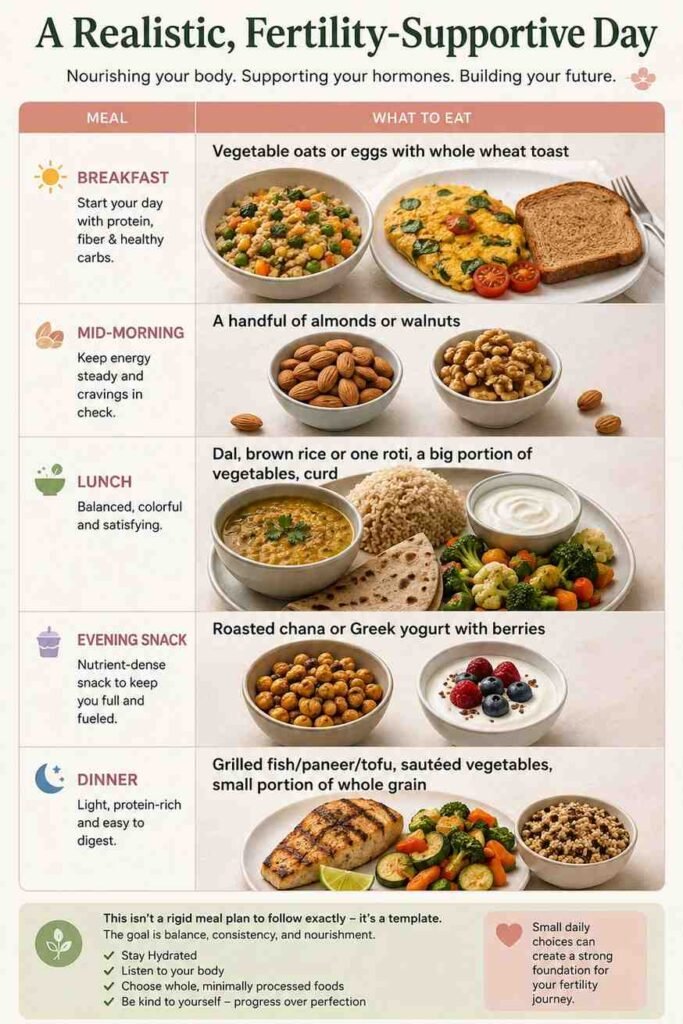
This isn’t a rigid meal plan to follow exactly — it’s a template. The goal is a plate that’s protein-forward, fiber-rich, low in refined sugar, and includes healthy fats, meal after meal.
Movement Matters Alongside Food
Diet alone isn’t the whole picture. Regular movement — even a daily 30-minute walk — improves insulin sensitivity independently of weight loss, meaning it helps your hormones even before the scale moves. Combining moderate aerobic activity with a couple of days of light strength training tends to produce the best results for both weight and menstrual regularity, without needing to become an athlete overnight.
Should You Consider Medical Help Alongside Diet Changes?
If you have PCOS, insulin resistance, or have been trying to conceive for over a year (six months if you’re over 35) without success, it’s worth having a direct conversation with a gynecologist or reproductive endocrinologist, alongside your dietary changes. Some doctors may discuss medications that improve insulin sensitivity, or in select cases, newer options like GLP-1 medications have shown promise in improving ovulation and pregnancy rates in women with obesity and PCOS — though these come with important considerations around timing, since you can’t be on most of these medications once you conceive.
Diet and lifestyle changes are the recommended first step for most women, but they work best alongside medical guidance, not as a replacement for it — especially if your cycles are significantly irregular or absent.
Supplements Worth Discussing With Your Doctor
Food should be the foundation, but a few supplements have reasonable evidence behind them specifically for women with obesity or PCOS trying to conceive. None of these should be started without your doctor’s input, but they’re worth bringing up:
Folic acid — this one isn’t optional or PCOS-specific; every woman trying to conceive should be taking it, ideally starting before pregnancy, to reduce the risk of neural tube defects.
Inositol (often myo-inositol or a myo-inositol/D-chiro-inositol combination) — this has a growing body of research specifically in women with PCOS, showing improvements in insulin sensitivity, ovulation, and egg quality. It’s one of the more well-studied supplements in this specific context.
Vitamin D — deficiency is common in women with obesity and has been linked to poorer reproductive outcomes. A simple blood test can tell you if you’re low.
Omega-3 fatty acids — supports insulin sensitivity and has some evidence for improving egg quality, though whole food sources like fatty fish are just as valuable as supplements.
Again — these aren’t replacements for the dietary changes above, and not everyone needs all of them. Your doctor can guide you based on actual bloodwork rather than guesswork.
Foods and Habits Worth Cutting Back On
Alongside what to add, a few things are worth actively reducing:
- Sugary beverages — sodas, sweetened juices, and even excessive fruit juice spike blood sugar rapidly and offer little nutritional value in return.
- Trans fats and heavily fried foods — commonly found in packaged snacks and fast food, these worsen insulin resistance and inflammation, both of which work against fertility.
- Excess caffeine — moderate amounts (1–2 cups of coffee) appear fine for most women, but very high intake has been loosely linked to reduced fertility in some studies, so moderation is the safer bet.
- Alcohol — best minimized or avoided altogether while actively trying to conceive, given its effects on hormone metabolism and early pregnancy risk if conception occurs unknowingly.
None of this requires perfection. The goal is shifting your overall pattern, not achieving a flawless diet.
This is the question everyone actually wants answered, and the honest response is: it varies, but often faster than people expect. Some women see improved cycle regularity within 2–3 months of consistent changes, particularly once they cross that 5% weight loss threshold. Others take longer, especially if PCOS is more severe. The key is consistency over the first 3–6 months rather than expecting overnight results — and not losing heart if the first month doesn’t show dramatic changes.
Frequently Asked Questions
How much weight do I actually need to lose to improve my chances? Research consistently points to 5–10% of your current body weight as a meaningful threshold where ovulation and fertility outcomes noticeably improve. For many women, this is a far smaller, more achievable number than they initially assume.
Is intermittent fasting a good idea while trying to conceive? It’s genuinely mixed — some women with insulin resistance find structured eating windows helpful for blood sugar control, but very restrictive fasting can also disrupt hormones further in some cases. This is worth discussing with your doctor rather than starting on your own, especially if your cycles are already irregular.
Can I still try to conceive naturally while working on weight loss, or should I wait? Most doctors recommend working on lifestyle changes for a defined window (often 3–6 months) while still trying, rather than putting family planning entirely on hold — especially since age also affects fertility. Your doctor can help you weigh this timeline based on your specific situation.
Does this apply only to women with PCOS, or to obesity in general? Both. While the connection is strongest and best-studied in women with PCOS, research shows weight loss improves fertility outcomes in women with obesity broadly, even without a PCOS diagnosis.
Will losing weight guarantee I’ll get pregnant? No, and it’s important to be honest about that. Weight is one significant, modifiable factor among several that affect fertility — age, egg quality, and other underlying conditions also play a role. But for many women with obesity, it’s one of the most impactful things they can influence themselves, alongside proper medical care.
A Gentle Final Word
If you’ve been carrying guilt or frustration about your weight and your fertility journey, please know this isn’t about blame. Obesity itself is a complex condition shaped by genetics, hormones, and circumstances far beyond simple willpower. What actually helps is a clear, realistic, sustainable plan — not shame, not crash diets, not chasing an unrealistic number on the scale.
Small, consistent changes to how you eat, combined with regular movement and the right medical support, genuinely move the needle for many women in this exact situation. Be patient with your body, be consistent with your habits, and don’t hesitate to bring your doctor into the conversation as an active partner in this process, not just someone who tells you to “lose weight” without a plan.
Disclaimer: This article is for informational purposes only and does not constitute medical advice. Please consult a gynecologist, reproductive endocrinologist, or registered dietitian before making significant dietary changes, especially while trying to conceive or if you have PCOS or another underlying health condition.
Related Articles: